Resilience Without Compromise: Why Synchronisation is the Quiet Battleground of IP Production
January 26, 2026
As seen in InBroadcast January 2026
Simen K. Frostad, Chairman of Bridge Technologies
Resilience Without Compromise: Why Synchronisation is the Quiet Battleground of IP Production
There aren’t too many contexts in which you’d want to hear the word ‘redundant’: to be unnecessary, extraneous, superfluous to requirements. But in the field of broadcast, it’s absolutely crucial – a form of insurance against the unexpected, ready to pick up seamlessly if (or, indeed, when) Plan A goes wrong. Or Plan B. Or even Plan C. Because the more paths of redundancy built into a system, the more remote the possibility of critical failure.
But building in that level of resilience across multiple layers of redundancy is no easy feat. It’s a careful balancing act between resilience, expenditure, and quality. And today, it’s no longer enough to have a backup. That backup needs to be ready to take over instantly, invisibly, and without consequence to the viewer.
The issue at hand
Maintaining multiple delivery paths for the same service has long been sound engineering practice – from satellite and fibre to modern mixes of IP, SRT and cloud – with each path kept deliberately independent to reduce shared points of failure. But that independence inevitably introduces timing differences. When switching between redundant sources, planned or otherwise, those differences can surface as sync errors or brief disruptions that directly impact quality of experience: subtle errors which – in a crowded media landscape with near-zero switching costs – can be enough to lose viewers.
And whilst IP has brought an endless range of benefits to media production and distribution, it has introduced a particular challenge in relation to redundancy sync. Unlike traditional SDI, where audio, video and ancillary data were inherently locked together, IP transports these elements as separate streams, enabling flexibility and scale but making synchronisation something that must be actively and carefully managed rather than assumed.
Sync Think
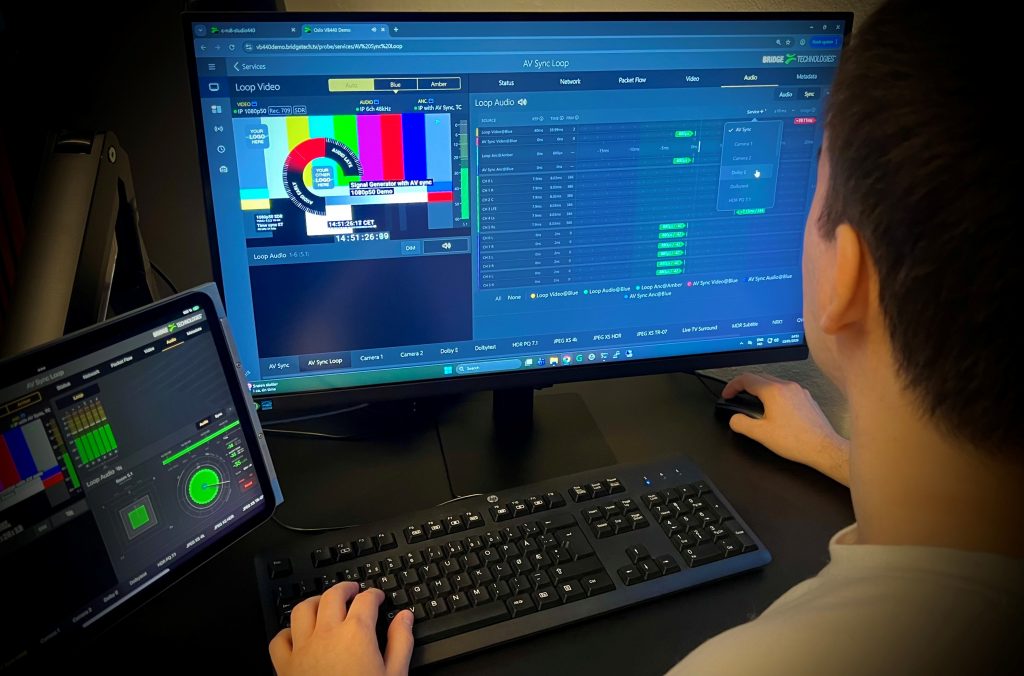
At Bridge Technologies, we’ve been synching big for a year or two now. It started with the development of the AV Sync Generator within our VB440 production probe, designed to maintain sync within a service. Rather than relying solely on transport-layer timestamps, the AV Sync Generator takes a more fundamental approach. It embeds machine-readable electronic markers directly into the video and audio signal, allowing synchronisation to be assessed at the content level once the service is reconstructed. In other words, it measures what the viewer will actually experience, not just what the packets claim.
This approach acts as a ‘first line of defence’ against sync issues within a service. Operators gain real-time, sample-accurate insight into the alignment between audio and video, supported by intuitive visual tools such as blink-and-beep reference cues, rolling shutter simulation, and colour bars. More recently, this capability was expanded to include ancillary data synchronisation, recognising that high value HDR data and immersive audio object data are no longer peripheral, but central.
Taking things a step further
But we realised that the potential for our synchronisation tool doesn’t stop there. In live sport and premium broadcast especially, it is common – and sensible – to deliver the same service via multiple, genuinely independent paths. One might arrive via satellite, another via SRT over IP, a third via a different network route entirely. Each path has its own latency characteristics, and in asynchronous transport environments, those differences are unavoidable. The problem comes when you try to switch between them.
Our latest enhancement to the AV Sync Generator addresses this directly by enabling frame-accurate comparison across multiple flows carrying the same service – i.e., redundancy paths. Engineers can now place parallel delivery paths onto a shared timeline within the VB440’s sync client, visually stacking them against a chosen reference. Timing offsets are immediately visible, allowing delays to be adjusted so that switching between sources can occur seamlessly – without glitches, jumps, or awkward moments that remind viewers something went wrong. New flows can be added to the timeline with a click, and the visual comparison is designed to support fast, confident decision-making in live environments. The aim is not to burden engineers with more data, but to give them clarity – at precisely the moment they need it.
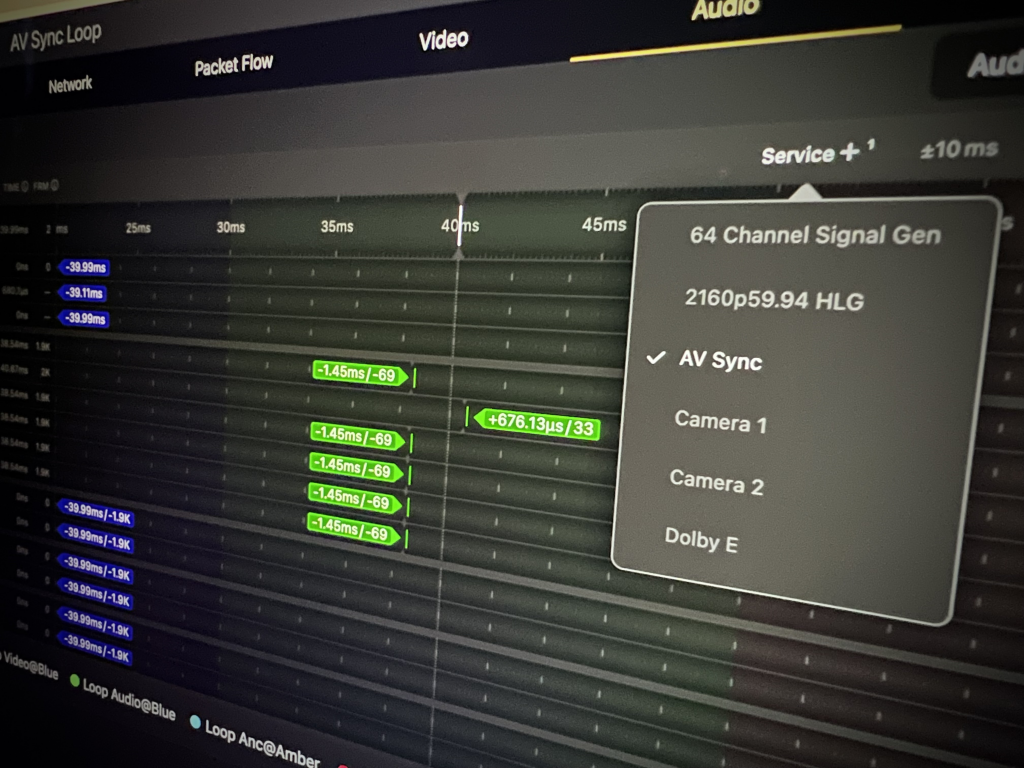
All of this runs within a standard HTML5 browser, accessible from anywhere, and available to multiple users simultaneously. And while APIs are in place to support future automation, the system is deliberately designed around human oversight. Synchronisation at this level often spans multiple domains and responsibilities; making it intuitive is not a compromise, but a requirement.
Change for all
Perhaps most importantly, this approach reflects a broader shift in how high-end production tools are delivered. Historically, advanced synchronisation – especially across redundant paths – was the preserve of Tier One broadcasters with specialist hardware, deep racks, and deeper budgets. The VB440 challenges that assumption. By consolidating synchronisation, monitoring, and diagnostics into a single, multifunctional, browser-based platform, we’re delivering best-in-class production control accessible to far more of the industry.
In an era where resilience is expected, cost pressures are constant, and audience loyalty is fragile, there is no room for compromise. As IP production continues to evolve, the quiet discipline of keeping everything in time, has just become fundamentally easier… with the VB440.