From MPEG-TS to CMAF: The Container Transition Reshaping OTT Delivery
August 18, 2026
INBroadcast July 2026
By Simen K. Frostad, Chairman of Bridge Technologies
Another acronym to muddy the waters
For the better part of two decades, MPEG Transport Stream (TS) has been the workhorse of broadcast and OTT delivery. Designed for the era of DVB and lossy RF transmission, TS came with built-in resilience: small 188-byte packets, forward error correction, and the ability to carry multiple programs within a single stream. It was, and remains, remarkably robust: and still has an important role to play in many distribution workflows. But robustness is not always elegance. And in the world of HTTP-based streaming, TS carries baggage.
Enter CMAF: the Common Media Application Format. Standardised by MPEG and now recognised with a Technology & Engineering Emmy Award, CMAF has the industry coming towards something that almost looks like consensus. It defines a single container format that can be referenced by both HLS and DASH manifests. One set of segments. One (sort of) encryption scheme. One storage footprint. Delivered everywhere.
In, out, shake it all about
Before going further, it is worth clarifying a distinction. When the industry talks about CMAF, it is actually talking about two different things. CMAF ingest defines how encoders send CMAF fragments to a packager – an internal workflow between a broadcaster’s own systems. CMAF egress defines how packagers publish those fragments for HLS and DASH playback to CDNs and ultimately to end consumers.
Our focus here is on the latter: the shift from MPEG-TS to CMAF as the container format for OTT delivery to viewers, and how this can be monitored effectively. But it is worth noting that the ingest side is evolving too. DASH-IF CMAF Ingest Interface‑1 has emerged as a standardised HTTP-based push ingest format for sending CMAF fragments from encoders to packagers, replacing legacy MPEG-TS ingest in modern OTT workflows.

So why CMAF?
Simply, because the advantages are substantial. For content distributors, CMAF eliminates the need to maintain parallel packaging pipelines for different protocols. For CDNs, cache efficiency improves dramatically when HLS and DASH reference the same byte-identical segments. For viewers, CMAF enables low-latency streaming through chunked transfer encoding, where partially complete segments can be played before the full segment downloads – pushing latencies down to the 2-to-5-second range without sacrificing scale. That is the sweet spot for live sports, news, and major events: not quite real-time, but far closer than traditional HLS.
Yet not everyone has made the swap. And the reasons are understandable.
The psychology of change never changes
So why is TS still a talking point if CMAF offers clear benefits?
The reasons are familiar: operator caution, migration costs, the hassle of updating packagers and validating players. For many, the perceived risk simply doesn’t justify the reward.
But here is the irony. The risk doesn’t seem to justify the reward because the reward comes from the risk. CMAF’s killer feature is cache efficiency – one set of segments served to both HLS and DASH. But broadcasters hedging their bets seek to run CMAF alongside TS. That means they’re not reducing their storage, caching and complexity – they’re doubling it. The very efficiency that makes CMAF attractive is undermined by the continued presence of the legacy format it was meant to replace. It’s a Catch-22.
Device fragmentation compounds the problem. Legacy TV firmware and the countless ‘long tail’ Android phones and tablets you have never heard of – still a massive chunk of the market – often lack the CBCS encryption support that unlocks CMAF’s universal playout advantage.
As a result, encoding pipelines must produce multiple outputs. Packaging layers must negotiate between standards. QA teams must validate against both. The elegant promise of ‘one format to rule them all’ collides with an entrenched market that is not ready to relinquish what they have, what they know, and what they can afford.
Monitoring the Change
This is where monitoring becomes critical – and where Bridge Technologies has built its reputation. CMAF egress needs to be monitored and understood on the level of segment validity, manifest correctness, and encryption compliance at the CDN edge, and that is exactly what the VB330 does. But it is also equipped to do the same for MPEG-TS, HLS, DASH, SmoothStream, RTMP, and MSYNC -because the VB330 has never been a single-format probe.
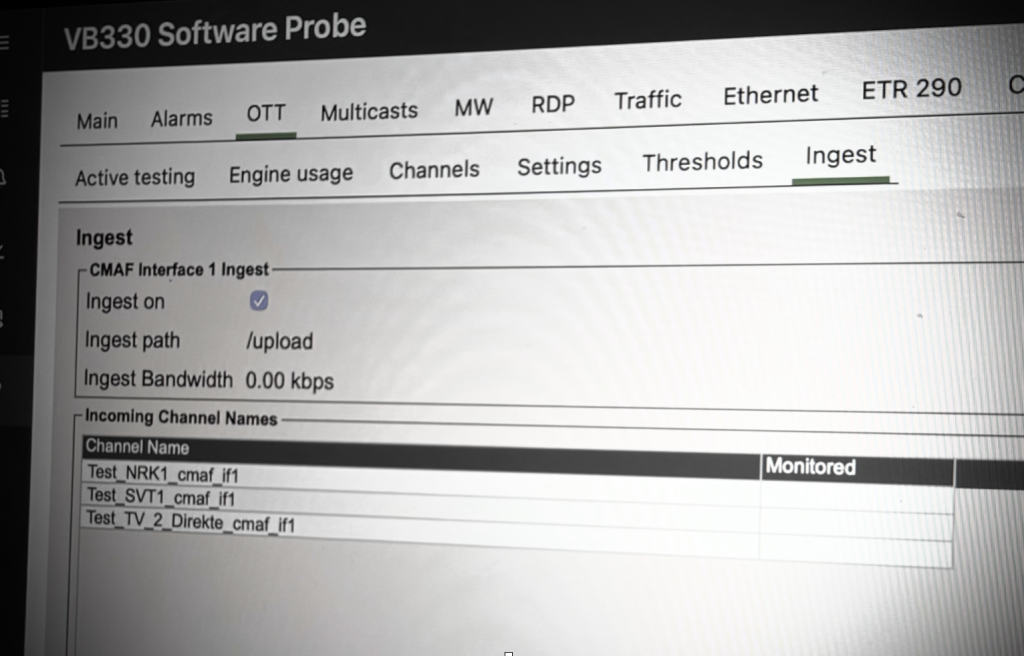
And with ingest workflows evolving, the VB330 is adapting there too. The new DASH-IF CMAF Ingest Interface‑1 support will allow the probe to receive and monitor incoming CMAF fragments from encoders, converting the input to DASH format for analysis – bringing the same unified visibility to the ingest side of the workflow. This will be demonstrated at IBC, with general availability expected by the end of the year.
So, whether a broadcaster is all-in on CMAF, still running MPEG-TS, or – as is most common – navigating the hybrid middle ground, the VB330 provides unified visibility across both ingest and egress.
Ultimately, the transition to CMAF is not a race with a finish line. It is a migration that will play out over years, shaped by device fleets, commercial agreements, and operational risk tolerance. Bridge’s role is not to dictate the pace, but to ensure that whatever container sits inside the packets, the people responsible for delivery can see exactly what is happening – from anywhere, in real time. Because operational reality is just as important as technical elegance.