Garbage in, garbage out: why data integrity matters for the future
October 28, 2026
InBroadcast Article
How to pass an interview (for a job you probably already have)
It is a classic trope – almost a cliché – that tech interviews will inevitably ask candidates to implement a sorting algorithm on a whiteboard. There are dozens of sorting algorithms – quicksort, merge sort, heapsort – each with different trade-offs in time complexity (referred to as their ‘Big O notation’), memory usage, stability, and adaptability to partially sorted data.
The candidate sweats, prays they remember whether the pivot goes on the left or the right, and turns to scribble on the whiteboard.
But the candidate that sets themselves apart isn’t the one who implements the solution fastest. It’s the one who stops, turns around and pushes back a little. Who understands that in this setting, there is an implicit assumption that the data is well-behaved: already clean, already structured, and already understood. But reality is rarely so kind. The best candidate is therefore the one who asks: “Where did this data come from? What generated it? What are the failure modes of those collection methods? Are there gaps? Biases? Calibration errors? What question are you actually trying to answer by sorting it?”
These questions matter. Because in the real world (and we’re counting broadcast engineering as the real world here, even though it can feel like its own fantastical realm sometimes) data is never clean. It arrives with packet loss, timing errors, misaligned timestamps, and a hundred other pathologies. Sorting a corrupted array is trivial. Detecting that the array is corrupted in the first place is the real problem.

Data with Intention
This distinction is not a theoretical observation. It is the core engineering principle that has guided Bridge Technologies for over two decades. We do not simply generate data. We design our probes with an inherent understanding of what that data actually means. The data we collect is not arbitrary. It is gathered at the points that matter, for the specific purpose of understanding something concrete: packet timing, PTP alignment, SCTE-35 cue validity, audio loudness, video sync, network redundancy.
Because we understand what we are measuring and why, we can present that data in ways that leverage that understanding. The VB440’s interface doesn’t just display numbers. It displays a waveform scope that a camera painter can read instinctively. It displays LUFS and Gonio meters that an audio engineer can balance against. Similarly, in the realm of distribution, our VB330 probe doesn’t just display mysterious metric readouts. It takes novel approaches to data display – for instance, in the form of our patented Mediawindow, using a ‘water-flow’ style presentation to give instant insight. The data is not merely visible. It is meaningful. Ready to be understood by the user who needs it, in the moment they need it.
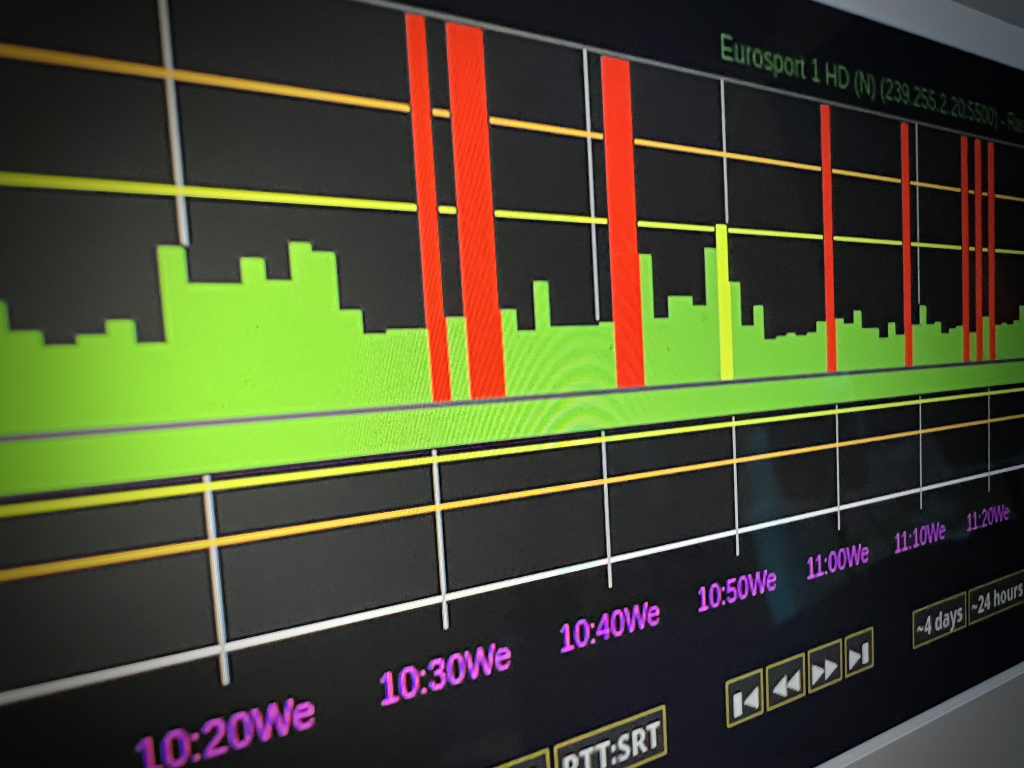
This approach has been fundamental to Bridge’s role in the industry, and a reason we’ve been a key voice at the many roundtables where IP knowledge has been painstakingly developed, lesson by lesson, implementation by implementation. Meetings, conferences and tradeshows, where the industry as a whole has progressively grown its understanding of how ST 2110 streams behave, how PTP timing works, how redundant paths should align. The readouts from Bridge probes can be trusted because they’re modelled on hard-won knowledge and data, not inference and conjecture.
AI and the Future of Data
Inference and conjecture provide a neat segue into our next point: the role of AI. Artificial intelligence is coming to broadcast. That is not a prediction. It is already here, and its presence will only grow, regardless of the pockets of resistance it might face.
But it’s important to remember that, at their core, AI tools are effectively pattern-matching engines. They ingest vast quantities of data, identify correlations, and generate outputs based on those correlations. And whilst many might throw their hands up at such an over-simplification, there’s one truth that can’t be denied: the quality of those outputs is directly limited by the quality of the inputs. Garbage in, garbage out. The principle has not changed. It has only become more consequential – indeed, it’s not difficult to foresee a time when datasets drawn from source will carry more value if they can be ‘guaranteed untouched’ by the greedy hands of AI.
But it is not our role to police the use of AI in network modelling and flow predictions. Our role is to promise that the datasets we provide – the packet captures, the timing measurements, the sync offsets, the audio levels – are meaningful, accurate, and fit for purpose. We make our data accessible in its base form, through APIs that allow outside applications to ingest it and build their own understanding. Whether that understanding comes from a human engineer or a machine learning model is, from our perspective, secondary. What matters is that the data itself can be trusted.
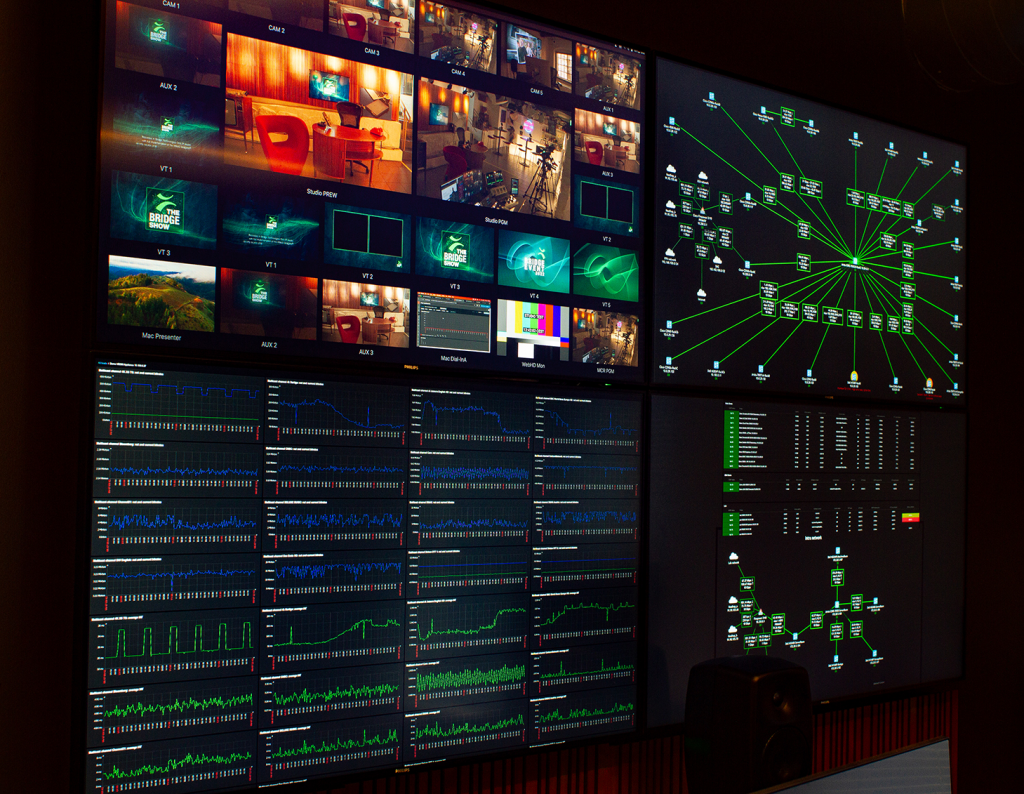
The Day-to-Day Vigilance
In the meantime, the work continues. The day-to-day reality of broadcast engineering still demands real-time answers, delivered at the speed of live production, by people who understand what they are looking at.
The industry’s responsibility will remain constant: Ask the right questions. Collect data at the right points. Find ways to make it intuitive and usable to those who need it. And above all, remember that data quality, relevance and accuracy will always be the cornerstone of good decision making.